Jablonski
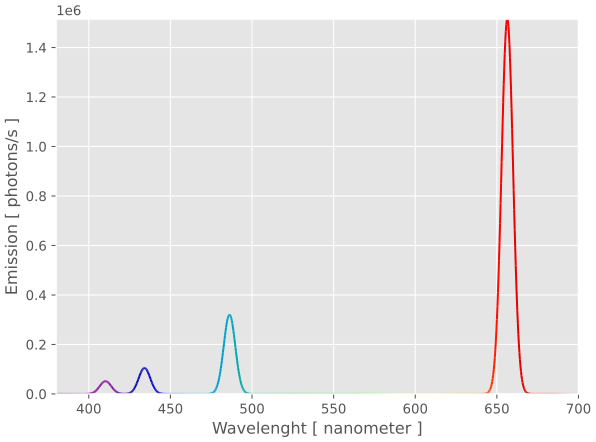
Jablonski is a Python-based package for simulation of photochemical systems. It extends poincare, a package for modelling dynamical systems. It's designed around:
-
Modularity: Jablonski is intended to create a layer to separate the actual declaration and simulation of models, allowing to easily switch between methods and compile to different backends (including NumPy Numba and JAX).
-
Composability: models are composable, allowing for the combination of smaller systems to create larger ones; complex models can be broken up into more manageable parts.
-
Reproducibility: it intends to be a centralized place for all information concerning models, making it easy to extract data about information and parameters and encouraging consistency between analytical formulations and numerical implementations.
-
Utility: jablonski contains a number of simulation and analysis tools, such as piecewise simulation for pulse excitations and getting a system's time resolved and steady state emission spectra.
Installation
It can be installed from PyPI:
or conda-forge:
Documentation
Documentation is structured as a series of interactive marimo notebooks which cover basic and advanced topics. They can be ran in the browser either in a static or interactive version or by cloning the dyscolab-tutorials repository to open them locally. For more information, see Pioncare's documentation.
Basics
- Getting started with Jablonski: the essentials necessary to use jablonski. Interactive / Static
GitHub
Jablonski is developed in it's github repo.